If you’re a mid-market manufacturer or construction firm, you’ve probably felt the change coming. The Department of Defense (DoD) is finalizing the Cybersecurity Maturity Model Certification (CMMC), and it’s raising the bar for everyone in the defense supply chain. Instead of simply saying you protect Controlled Unclassified Information (CUI), you now have to prove it clearly and consistently.
For many teams, that’s easier said than done. CUI shows up in more places than people realize: CAD models, build sheets, cloud-based plan rooms, email exchanges with subcontractors, and even jobsite devices that come and go. Wherever it flows, CMMC follows.
So if you’re trying to figure out what this means for your upcoming bids or how fast you need to move, you’re in the right place.
→ Book a CMMC Readiness Consult with IT Solutions.
CMMC requirements now flow down through the supply chain via Defense Federal Acquisition Regulation Supplement (DFARS) clauses, meaning many midsize contractors qualify simply by touching CUI, whether directly or through subcontracted work.
For manufacturers, CUI often moves across CAD platforms, PLM systems, and shop-floor technologies. Many plants also blend traditional IT with industrial control systems (ICS/OT), where segmentation and logging aren’t as mature.
For construction firms, the challenge is different: mobile crews, shared plans hosted in cloud environments, varied subcontractor devices, and jobsite networks that don’t always meet enterprise standards.
Failing a CMMC assessment or failing to post required information to the Supplier Performance Risk System (SPRS) can disqualify you from award consideration.
A CMMC assessment reviews how well your security controls match the level required in your contract and whether you can prove those controls are in place. Depending on the solicitation, Level 2 may allow self-assessment or require a C3PAO, while Level 3 is performed by a DoD assessment team.
What you can expect:
The DoD’s program rule (32 CFR Part 170, Federal Register, Oct. 15, 2024) outlines the model structure, while the CMMC Assessment Process (CAP v2.0) from Cyber AB explains how C3PAO-led reviews are executed.
A CMMC assessment follows a predictable flow: determine scope, assemble documentation, perform the review, and post results to SPRS. Any gaps may be placed on a POA&M if allowed and later closed out.
Key steps:
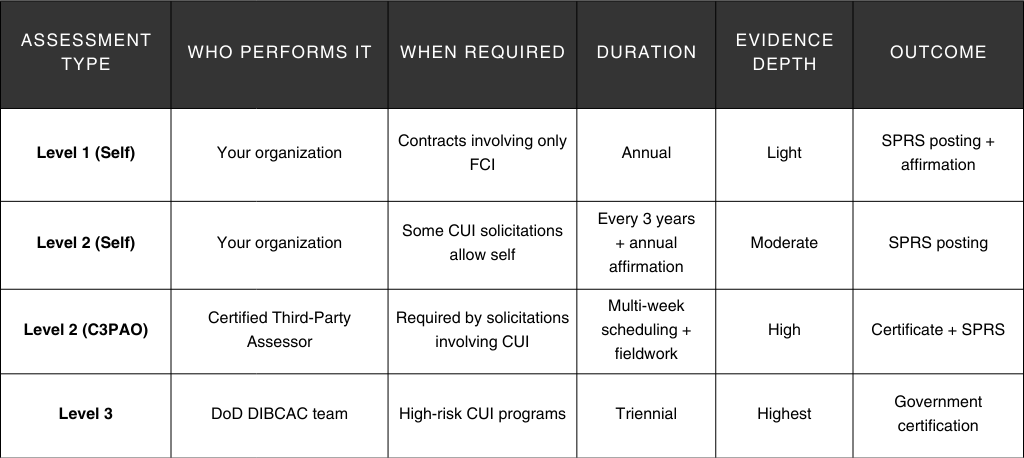
Expect fieldwork to take anywhere from a few days to several weeks. The real timeline depends on evidence readiness, the complexity of your environment, and how quickly you can remediate gaps.
Time factors include:
If your documentation is complete, a self-assessment moves quickly. If not, remediation often takes several months.
Falling short doesn’t end your chances if the gap is eligible for a POA&M. Under 32 CFR Part 170, the DoD permits limited POA&M items but not for the highest-impact controls.
Key considerations:
After remediation, an assessor (or C3PAO) reviews the updated evidence to validate closure.
Start here:
→ Ready to verify your environment? Contact IT Solutions to start your readiness review.
CMMC isn’t purely a paperwork exercise. Decisions about scope, tooling, and timing all affect cost and compliance.
Watch for:
Good scoping and early evidence preparation often make the difference between passing and a long remediation slog.
You can manage a self-assessment alone, but certain situations call for experienced guidance:
→ Book a CMMC Readiness Consult
IT Solutions helps manufacturers and builders align systems, documentation, OT environments, and subcontractor workflows with CMMC requirements so you can pass on the first attempt or close gaps quickly.

We’ve got answers — fast, clear, and tailored to your needs. Let’s talk tech.